
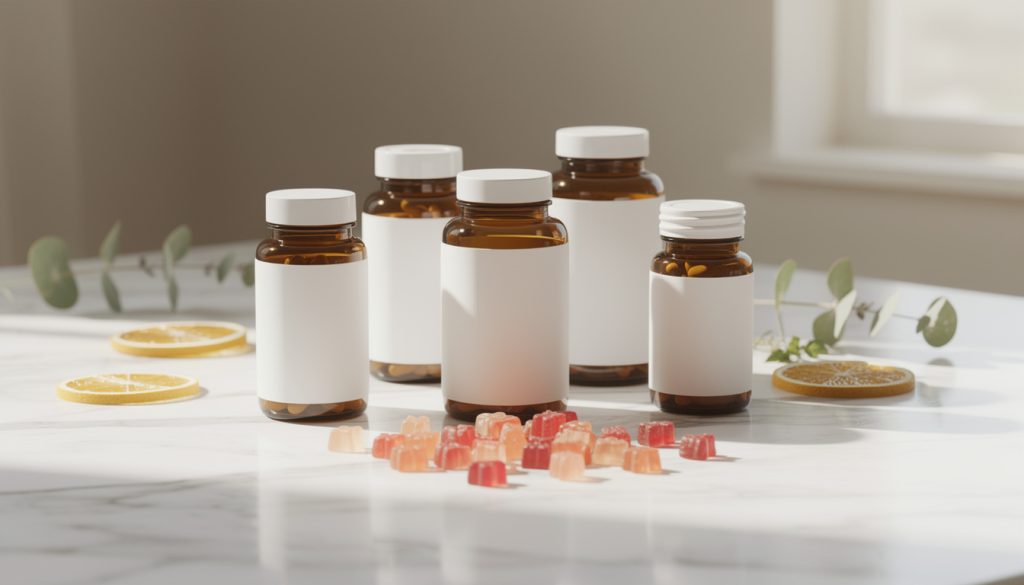
Private Label Prenatal Gummies for Women’s Wellness Lines: A Comprehensive Guide examines why private label prenatal gummies have become an accessible, high-compliance alternative to traditional capsules. Chewable formats suit consumers who struggle with large tablets, and daily adherence tends to be better when the product is pleasant to take. The guide covers formulation engineering, quality assurance, packaging barrier requirements and the operational workflow of launching a women’s wellness line.
Private Label or Contract Manufacturing: Where the Line Falls
Private label supplement manufacturing relies on pre-developed stock formulas that receive a brand's name, artwork and sometimes minor flavor or color adjustments. Contract manufacturing in the full sense builds a bespoke formula from scratch, with custom ingredient selection, dosing and testing. The first route shortens timelines and lowers development cost. The second offers differentiation at the price of longer R&D.
Nutraceutical gummies carry particular appeal in maternal health. Morning sickness can make swallowing large capsules unpleasant, pill fatigue erodes daily routines, and a soft chew is often tolerated better by a sensitive digestive system.
Ownership boundaries deserve early definition. A brand typically owns its name, artwork and claims, while the manufacturer retains rights to stock formulas unless a custom formula is commissioned and assigned in writing. Responsibility for label accuracy rests with the brand owner, and production conduct rests with the manufacturer.
Why Iron Rarely Fits: Nutrient Profiles and Formulation Constraints in Gummy Delivery
Core Micronutrient Inclusion and Technological Tradeoffs
A prenatal multivitamin gummy usually centers on folate, vitamin D3, iodine and vitamin B12. Methylfolate is the already-active form, which may suit consumers whose conversion of synthetic folic acid is less efficient, while folic acid remains the better-documented and cheaper option. The maternal micronutrient guidelines from the NIH Office of Dietary Supplements set out recommended intakes that formulators can use to benchmark label claims.
Elemental iron and calcium are the difficult cases. Iron introduces metallic off-notes and can interact with the gelling matrix, while calcium is bulky, and a meaningful dose would swell each piece beyond a comfortable size. Choline and botanical extracts face the same volume ceiling, so serving size becomes a trade-off, with two gummies offering convenience and four allowing fuller dosing.
Base Gelling Agents and Flavor Engineering
Pectin gummies are plant-based, citrus-derived and hold their shape at higher temperatures, which helps in warm transport. Gelatin gummies are animal-derived, with a characteristically chewy bite but lower heat tolerance.
Taste masking has to neutralize bitter B-vitamin complexes and mineral astringency. Approaches include acid balancing, natural fruit flavor systems and encapsulated actives, which avoid leaning on excess sugar or artificial additives.
What Should a Batch File Prove? Quality Control and Testing Protocols
Facility Verification and Process Controls
Production belongs in a GMP-compliant facility operating under 21 CFR Part 111, with controlled cleanroom zones and strict contamination prevention. Supplier qualification covers every raw botanical and chemical input, linking each lot to documented origin and specifications so that traceability holds across the supply chain. An allergen control program, including line segregation, cleaning validation and scheduling, prevents cross-contact with major allergens.
Analytical Testing and Batch Release Documentation
Release testing begins with identity testing of raw materials by HPLC or FTIR spectroscopy. Safety panels include heavy metals testing for lead, arsenic, cadmium and mercury, and microbial testing for aerobic plate count, yeast, mold, Salmonella and E. coli.
The Certificate of Analysis (COA) reports results against stated specifications. A credible COA names the batch, the method and the testing laboratory, and it should be supported by third-party testing for each finished batch. Prenatal products also sit within the wider context of antenatal nutritional interventions described by the World Health Organization, which frames what supplementation is meant to achieve.
Stability and Packaging: Metrics That Decide Shelf Life
Nutrient Overage and Degradation Management
Heat, pH and water activity accelerate the loss of vitamin C, thiamine and folate during cooking and deposition. Overage (nutrient overage) compensates for this loss by adding a calculated excess at batch stage, based on measured degradation, so that potency over shelf life still meets 100% of the label claim at expiry, typically 18 to 24 months.
Stability testing runs in two tracks. Real-time chambers hold product at storage conditions for the full dating period, while accelerated chambers, commonly 40°C and 75% relative humidity, predict degradation sooner.
Container Closure Systems and Barrier Protection
Gummies are hygroscopic, so packaging barrier properties must block moisture ingress, oxygen and UV light. Each option involves a different compromise.
| Component | Function | Consideration |
|---|---|---|
| PET bottle | Clarity, lighter weight | Weaker moisture barrier unless tinted or coated |
| HDPE bottle | Stronger moisture barrier, opaque | Blocks light; less shelf visibility |
| Induction seal | Tamper evidence, airtight seal | Requires compatible liner and closure |
| Desiccant liner | Absorbs residual humidity | Sizing must match headspace volume |
| Child-resistant closure | Prevents accidental access | Must preserve the seal integrity |
Common Costing Mistakes in Scalable Launches
The main cost drivers of private label prenatal gummies are the actives. Methylated folate and microencapsulated minerals cost far more than commodity blends, and a formula built on them is priced accordingly. A frequent mistake is comparing quotes without checking which forms of each nutrient are being quoted.
Unit cost also moves with order volume, custom tooling and dies, organic certification and natural flavoring systems. Batch minimum order quantities matter because gummy lines run in fixed cycles, and production scrap allowances, usually written into the quote, absorb start-up and changeover waste. A smaller first run, a staged purchase order or a pilot batch limits exposure before inventory is committed under any contract manufacturing agreement.
Scenario: A Prototype Approved on the Bench, Drifting at Scale
A reliable development path starts with formula benchmark selection, followed by lab-scale pilot sampling, organoleptic review of taste, texture and appearance, and a packaging artwork compliance check against labeling rules. In private label supplement manufacturing, the stock base shortens the early steps but does not remove the later ones.

Scale-up exposes problems invisible at benchtop level. Texture drift, sugar crystallization, surface sweating and uneven active dispersion can all appear once a prenatal multivitamin gummy moves into commercial depositing. Retained samples and in-process checks catch them early.
The contract should fix acceptance criteria before dispatch: assay tolerances, batch release thresholds, permitted defect rates and the remedy for a failed lot.
Are prenatal gummies a full substitute for capsules?
Not always. Gummies often omit or reduce iron and calcium because of bulk and taste constraints, so the formula's nutrient coverage needs to be stated clearly on the label.
Is pectin always the better base?
Pectin suits plant-based positioning and warm transport. Gelatin delivers a different chew and remains common, so the choice depends on audience and distribution conditions.
Why is overage used in gummy formulas?
Cooking and storage degrade some vitamins. Added overage keeps potency at or above the label claim through the end of shelf life.
What proves a batch is safe for release?
A Certificate of Analysis covering identity, heavy metals and microbial results, ideally verified by an independent laboratory, accompanies each finished batch.
About the Business
Maya Plus is a leading manufacturer of high-quality food supplement and vitamin gummies, offering private label solutions tailored to health-conscious consumers, retailers and businesses. The company develops innovative gummy formulations for men, women, kids, sports nutrition and beauty applications. Its work is defined by adherence to high manufacturing standards, formulation integrity and customized support for each brand.